Each week will contain an introductory video I have created that explains the work for the week. It will also contain links to what needs to be read or watched, as well as links to any new assignments any Discussion and Design Journal prompts. My goal is to have the video and assignment for the following week posted the Thursday or Friday prior. The schedule is subject to change; it is your responsibility to check it regularly.
Assignment for Week NINE: due by Sunday 10/25 by 11:00pm. This week we are going to shift focus and move into photography and how we can use photographs to tell stories. As we did with writing, we’ll be looking at the history of photography, but we’re going to get to that toward the end of the Photography unit so you can get outside and take photos while the weather is still nice and there are leaves on the trees.
Then, I’d like to introduce you to Ruddy Roye, who is using photography to communicate visually stunning, soulful, and compelling stories. Please go to Ruddy Roye’s professional site and look at the images under the series “When Living is a Protest” (and explore the rest of the site, as you’d like). You can also check out Roye’s Instagram page, if you’d like. Then, watch the below videos, which in different ways they both showcase his approach to telling stories (note that they are both promotional videos for Fuji Cameras so there is some Fuji hyping in there, too):
Discussion and Design Journal Entry This week we’re back to the written Discussion and Design Journal Entries, with a bit of a visual twist. There are 3 parts:
In the Discussion portion of your entry, I’d like you to to consider the idea that photography can be used to communicate and tell stories. Quote from and mention specific photographs from each photographer to support and/or inform your claims. Then, I’d like you to paste in one photograph you have found online (give that photographer credit!) that you think embodies either the work of duChemin OR Roye and discuss why.
Don’t forget to complete the Reflection part of the Entry!
Since I am assigning this later than I have other weekly assignments, please complete your work by Sunday 10/25 by 11:00pm.
Week One (8/24-8/28): Introduction to the Course
Week One Video
Assignment for Week One
We’re going to get started pretty slowly this week just to make sure I can work out any asynchronous kinks that might occur. So, just a few little assignments and then we’ll get going next week.
Please read through the course web site carefully and post two questions you have about it to this anonymous form:
This week I will be sharing with each of you a GoogleDoc where I’d like you to add some background info about your learning up to this point in your educational career. This information will remain between me and each individual student.
Please complete the above work by 8/28 at 5:00pm.
If you have any questions or concerns, please don’t hesitate to email me.
Week Two (8/31-9/4): Evolution of the Alphabet and the Future of Languages
Assignment for Week Two: Due Friday 9/4 at 11:00pm The assignment for week two will get us started thinking about communication, focusing specifically on the history of writing and the fragile future for many of the world’s languages. In doing so, you will be introduced one of the main concepts of the semester: the technologies we use — and language is one of the main technologies we use daily — are not neutral. That is, embedded within them are complex histories, social hierarchies, politics, and human biases, to name a few impactful structures.
Don’t wait until the last minute to start this work, as it will take time.
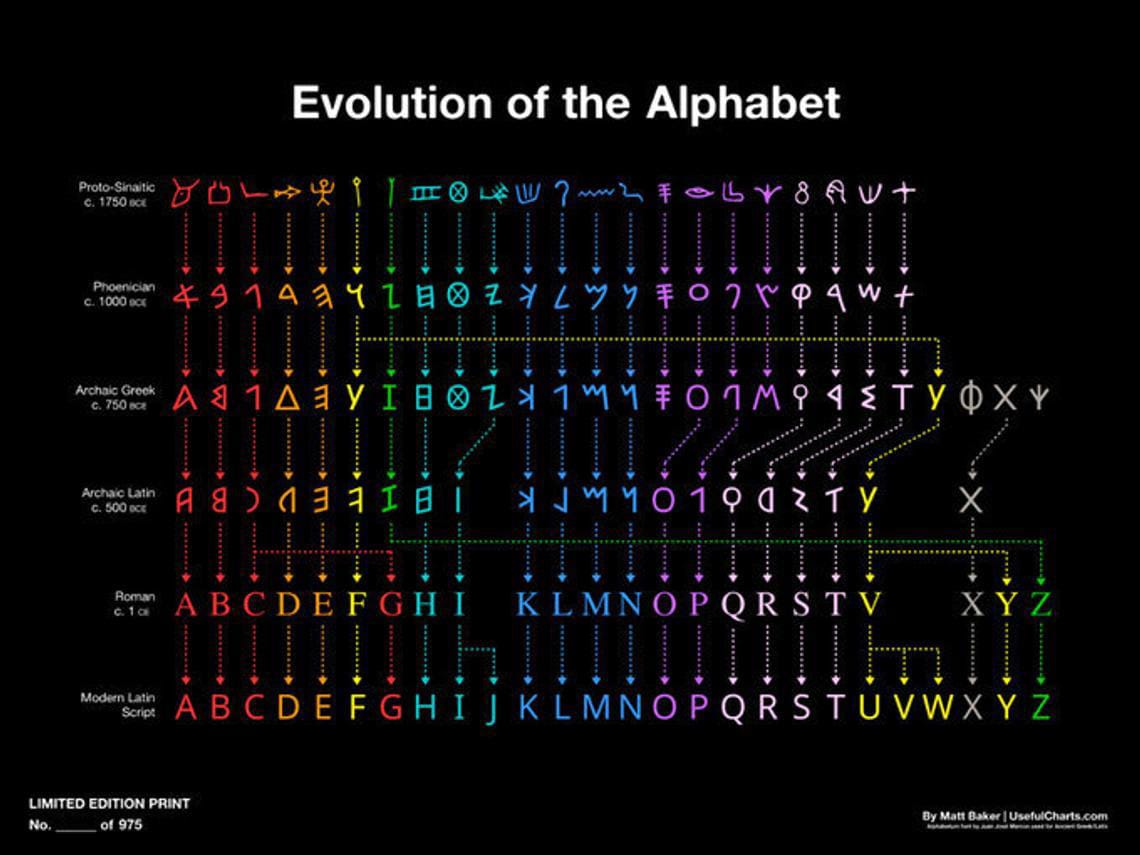
To begin, I’d like you read selections from Andrew Robinson’s wonderful book, The Story of Writing. You can download a PDF of the selections on the Readings and Texts page (the password is in the email I sent to the class earlier in week 1). The reading ends with the Greeks, but you can see the continued evolution of writing that led to the Latin alphabet in the below image created by Matt Baker:
(As I was preparing this assignment, my boys saw that graphic and decided to write their names in Proto-Sinaitic. You might try the same!)
Robinson’s book is wonderful because it presents nuanced facts incredibly well and has excellent evidence to illuminate the points he is making. But, it does not contain much in terms of the social, political, and ethical implications of how languages evolved.
That is exactly what director David Grubin presents in the fascinating documentary, Language Matters with Bob Holman, released on PBS in 2015. The documentary is 1 hour 50 minutes long and I strongly recommend you watch the entire thing. But, if you are pressed for time, skipping the content between 0:55:45 and 1:09:40 won’t cause you to miss anything truly vital. You can find a link to the documentary under Grubin on the Readings and Texts page.
To watch it, you must complete these steps in this order:
Click on the Language Matters with Bob Holman link from the Readings and Text page
Click the red Get Started link toward the middle of the page. Do not click the login link in the top right.
Log in with your SJU email and password.
Click the back button until you get to the Readings and Texts page.
Click the Language Matters with Bob Holman link again.
You should now be able to press play.
I know it’s a convoluted process and I’m sorry about that. If you have any trouble getting it to work, let me know.
Weekly Discussion Journal Entry For your first Weekly Discussion Journal entry, I’d like to respond to the following prompt:
I’d like you to think about how the reading and documentary reveal how writing and language are not neutral (as I wrote above) and how the structures embedded within them have impacted the societies where those languages are spoken and written. Please refer to and/or cite both the Robinson reading and the documentary (which very nicely comes with a full transcript).
Don’t forget to complete the Discussion and the Reflection. See the assignment for specifics and requirements. All content MUST be written in that document. You cannot write it elsewhere and paste it in.
This video introduces the concepts that will be covered in the work we complete during week 3. Note that the video was created a few years ago and may have references to prior sections and a slightly different website layout. Everything still applies here.
Assignment for Week Three: Due Saturday, September 12 by 11:00pm The assignment for week three is going to move us from the evolution of the alphabet and the implications of language loss, which we learned about in week two, to the evolution of print. We’ll be watching videos on the subjects of moveable type, which was invented in China, the Gutenberg printing press, the last press in the United States that uses traditional hand-crafted printing methods, and the invention of word processing. To contextualize those videos, we’ll be reading sort selections from Jay David Bolter’s book, Writing Space: Computers, Hypertext, and the Remediation of Print (2001), which can be found on the Readings and Texts page.
Please complete the work in the following order: read Bolter, “Writing as a Technology.” Then, watch the four videos. Then read Bolter, “Remediation.”
Since we’re starting the week with Labor Day, for your second Discussion Journal entry, please respond to the following prompt by Saturday, September 12 by 11:00pm:
On page 19, Bolter writes: “The technical and cultural dimensions of writing are so intricately related that it is not useful to try to separate them: together they constitute writing as a technology.” Try to break that sentence down a bit. What does Bolter mean by “technical and cultural dimensions of writing”? Why and how are they so “intricately related”? Think about how you might see that represented in the evolution of print as depicted in the videos. What do those changes say about the changes in human culture (don’t make assumptions about differences between nationalities) from the time when humans first invented moveable type to Engelbart’s 1968 presentation? Why do you think some people still enjoy using traditional methods?
There are lot of questions in that prompt and you don’t need to address them all. Just go where your ideas take you, ensuring that you are discussing the videos in terms of Bolter’s ideas.
Don’t forget to complete the Discussion and the Reflection, including the required questions. See the assignment for specifics and requirements. All content MUST be written in that document. You cannot write it elsewhere and paste it in.
Week Four (9/14-9/18): Social Media, Algorithms, and AI
Week Four Video
No video this week.
Assignment for Week Four: Due by Saturday, September 19 at 11:00pm The assignment for week four is going to leap-frog us from the invention of word processing, which is where we ended in week three, to our contemporary social media and AI moment.
In the years leading up to the invention of social media, internet scholars and technology critics lauded the democratic, egalitarian possibilities of the internet, calling it, as Harold Rheingold did in 1993, a “virtual community” where the technology that hosts it “has the potential to bring enormous leverage to ordinary citizens at relatively little cost–intellectual leverage, social leverage, commercial leverage, and most important, political leverage.” But, Rheingold warned, “The same tool, improperly controlled and wielded, could become an instrument of tyranny. The vision of a citizen-designed, citizen-controlled worldwide communications network is a version of technological utopianism that could be called the vision of ‘the electronic agora.’ In the original democracy, Athens, the agora was the marketplace, and more–it was where citizens met to talk, gossip, argue, size each other up, find the weak spots in political ideas by debating about them. But another kind of vision could apply to the use of the Net in the wrong ways, a shadow vision of a less utopian kind of place.”
The work for this week will ask us to look into that “less utopian kind of place” and see what we think about what we see.
Toward that end, I’d like you to read four articles and watch one documentary (links on the Readings and Texts page) in chronological order:
Hatzipanagos (2018) on online hate (from The Washington Post)
Noble (2018) on algorithms (from her book, Algorithms of Oppression) (Note that this reading analyzes the social and racial implications of Google search results of innocuous terms, such as “Black girls” and “Latina girls,” that resulted in sexualized language and references to pornographic depictions of women)
Orlowski (2020), The Social Dilemma documentary
Warzel and Wong (2025) on Grok (from The Atlantic)
Bogost (2026) on student booing AI (from The Atlantic)
For your third Discussion Journal entry, please respond to the following prompt by Saturday, September 19 at 11:00pm:
I’d like you to think about the implications for us as human beings and global citizens as a result of what we read and watched for this week, particularly in terms of the control that technology has over our lives.
We started this semester thinking about whether technology is neutral or not, but the texts for today suggest the question: how can we ever not be consumed by or manipulated or controlled by the information technologies that we use every second of the day (some even when we sleep as they monitor our breathing).
There are many cliched answers here — “the good outweighs the bad,” “I’m not addicted,” “here’s nothing we can do about it because all my friends and family use it” — and so on. Avoid all these, and more.
I want to read truly what you think about the way that these technologies, shape our actions, alter our livelihoods, and impact whether we live or die. (We’re a long way from moveable type….)
Please cite the texts in our discussion. Make sure to complete the Reflection portion of your response and include questions. And remember, feel free to exceed the word count. Let loose and let me know what you think about what is happening all around us.
Week Five (9/21-9/25): Copyright; Intro to Graphic Design and the Grid; Draft 1
Assignment for Week Five: Due Saturday, 26 by 11:00pm The assignment for week five is going to get us started on our first major project, the Design Assignment. In this assignment you will be learning about and putting into practice the fundamentals of graphic design. The project will be completed over a series of weeks, with each week’s work building on the prior week, resulting in very different drafts from week to week. It will be, I hope, a challenging and fun assignment to complete.
By the end of this week you will have complete Draft 1.
Please note there is a lot of content this week, which will require you to complete it over a period of days. Do not attempt to complete it in one sitting.
Preparing for the Assignment: Copyright To prepare for the assignment I’d like you to watch two videos and read one short article on copyright. We’re learning about copyright because understanding the concept is essential for all creators and because for Design Assignment we will be using material obtained from the web. Knowing what material we can use and why is important. You work falls under the heading of Fair Use. The videos and text are:
Completing the Assignment Once you have completed the Copyright work, I’d like you to read the Design Assignment. You’ll see an overview of the assignment and then the first of what will be several specific weekly assignments. You are to complete all of the steps under the Week 5: Graphic Design Fundamentals and Draft 1 heading. I have created 2 tutorials for you and there are also several videos to watch. They all must be watched in order to complete the assignment.
Discussion and Design Journal Entry This week will be the first of several weeks that feature design work in your Discussion and Design Journal. See the assignment for specifics of what to include in Design entries. Use the same Discussion and Design Journal GoogleDoc you have been using all semester, but follow the Design guidelines in the assignment:
Design entries are to be completed during the weeks when you are working on your designs (or photographs). Each Design entry will have two sections, the Designs and the Reflection:
The Designs: This entry should include 3 screenshots of various stages of the design (or photography) work you have completed and a 30 – 50 word description directly under or above each screenshot of what you were trying to achieve in each example. In your description, highlight various design (or photography) techniques you were attempting to employ.
The Reflection: In 50 – 75 words, discuss how the work challenged you as a designer (or photographer) and list 1 or 2 questions you have about your designs (or photographs).
Because there is much to complete this week, I’m making the deadline be Saturday, 26 by 11:00pm.
This video introduces the concepts that will be covered in the work we complete during week 6. Note that the video was created a few years ago and may have references to prior sections and a slightly different website layout. Everything still applies here.
Assignment for Week Six: due by Saturday, 10/3 at 11:00pm The assignment for week six is going to have us continuing to work on the Design Assignment. Specifically, we are going to be making color and typography choices. You can work on the color first or the typography first, it doesn’t matter, and I have broken the work into sections based each.
Completing the Assignment You will find the assignment under the Week 6: Color and Typeface Theory and Draft 2 heading on the Design Assignment page. I have created 2 tutorials for you, and there is some reading and a few videos to watch. They all must be watched in order to complete the assignment.
Discussion and Design Journal Entry As you are completing the work on your typography and color, be sure to take screenshots so you can add them to your discussion and design journal. See the assignment for specifics of what to include in Design entries. Use the same Discussion and Design Journal GoogleDoc you have been using all semester, but follow the Design guidelines in the assignment:
Design entries are to be completed during the weeks when you are working on your designs (or photographs). Each Design entry will have two sections, the Designs and the Reflection:
The Designs: This entry should include 3 screenshots of various stages of the design (or photography) work you have completed and a 30 – 50 word description directly under or above each screenshot of what you were trying to achieve in each example. In your description, highlight various design (or photography) techniques you were attempting to employ.
The Reflection: In 50 – 75 words, discuss how the work challenged you as a designer (or photographer) and list 1 or 2 questions you have about your designs (or photographs).
Because there is much to complete this week, your drafts and your Journal entry will be due by Saturday, 10/3 at 11:00pm.
If you have any questions, please let me know.
Week Seven (10/5-10/9): Advanced Design, Graphics, and Design
Week SEVEN Video
This video introduces the concepts that will be covered in the work we complete during week 7. Note that the video was created a few years ago and may have references to prior sections and a slightly different website layout. Everything still applies here.
Assignment for Week Seven: Due by Friday, October 9 at 11:00pm The assignment for week seven is going to have us continuing to work on the Design Assignment. Specifically, the work for week 7 is going to radically transform your project, as the last two weeks were essentially designed to introduce you to some design concepts and the Canva workspace, both of which I have been pleased to read in your Discussion and Design Journals have been new to many of you.
Please note that due to Fall Break, and my preference not to assignment work over much needed breaks, I have suggested the work be due this Friday instead of the usual Saturday. If you would like an extra day, please just email me letting me know.
Your poster from this week forward will now be advertising a fake exhibit for the subject you have chosen at the The Frances M. Maguire Art Museum, which is a beautiful brand new museum on the SJU campus housed in the former Barnes Museum space.
I recently learned about Poster House, a museum in New York City dedicated to the art and messaging of posters. You might be interested in checking it out.
Completing the Assignment You will find the assignment under the Week 7: Advanced Concepts, Purpose, and Graphics and Draft 3 heading on the Design Assignment page. I have created 1 tutorial for you and there are also a few videos to watch. They all must be watched in order to complete the assignment (the linked-to Canva tutorials are not required, but could help with specific Canva functions).
Discussion and Design Journal Entry As you are completing the work on your typography and color, be sure to take screenshots so you can add them to your discussion and design journal. See the assignment for specifics of what to include in Design entries. Use the same Discussion and Design Journal GoogleDoc you have been using all semester, but follow the Design guidelines in the assignment:
Design entries are to be completed during the weeks when you are working on your designs (or photographs). Each Design entry will have two sections, the Designs and the Reflection:
The Designs: This entry should include 3 screenshots of various stages of the design (or photography) work you have completed and a 30 – 50 word description directly under or above each screenshot of what you were trying to achieve in each example. In your description, highlight various design (or photography) techniques you were attempting to employ.
The Reflection: In 50 – 75 words, discuss how the work challenged you as a designer (or photographer) and list 1 or 2 questions you have about your designs (or photographs).
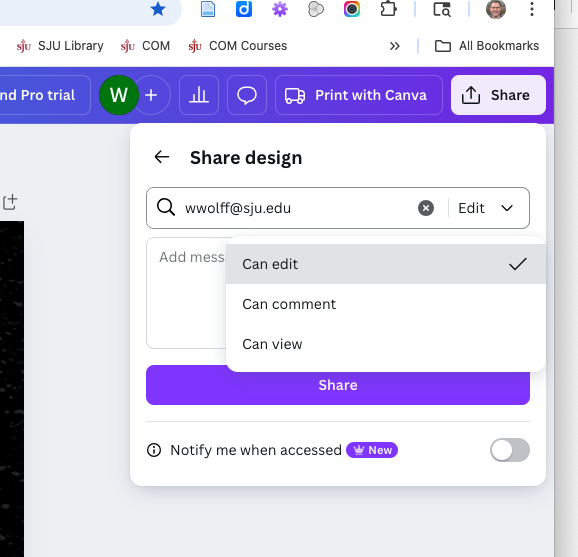
Sharing Your Drafts So I am able to create video comments on your work, please share it with me through Canva by following these steps. Do this even if you have shared it with me already:
Go to your design.
In the upper right click the white Share button.
Enter Bill’s SJU email into the field.
Select Edit from the pulldown menu so I can edit.
Click the purple Share button.
Note in the Week 7 space in your Discussion and Design Journal that you have shared it with me.
Week Eight (10/12-10/16): Rule of Thirds, Color Contrast, Final Drafts and Presentations Due
Fall Break: Monday, 10/12
Week EIGHT Video
This video introduces the concepts that will be covered in the work we complete during week 7. Note that the video was created a few years ago and may have references to prior sections and a slightly different website layout. Everything still applies here.
Assignment for Week Eight: Due by Monday, October 19 by 11:00pm The assignment for week eight is going to have us completing the Design Assignment. Specifically, the work for week 8 is going to be finishing and submitting your poster and a 12-slide, less-than-5-minute presentation about the poster in which you discuss your design decisions.
To help inform the final draft of your poster, have added video comments on all drafts that were shared with me by Wednesday morning, October 14. Please watch the whole video and not just your own, because I cover different concepts and ideas on different drafts and seeing those will help you with your revisions. If you don’t see yours it is being you didn’t share with me a version of your Canva space work that has the rough draft. The video is part of the Week 8 assignment (linked below).
Completing the Assignment You will find the assignment under the Week 8: Final Design and Presentation Due heading on the Design Assignment page. I have created one tutorial for you, which must be watched you so know how to create and submit your presentation.
Discussion and Design Journal Entry The discussion and design journal entry this week will ONLY consist of links to your final poster and final presentation. No other content is required.
Links to your work are due by Monday, October 19 by 11:00pm.
If you have any questions, please let me know.
Wednesday, October 14: Midterm Grades Submitted to University