It’s not required, but you might also look up something that interests you about Hendrix’s version of “Star Spangled Banner” that you could share with the class on Wednesday.
If you have any questions, just let me know.
W 1/14: Case Study 2 (music vs lyrics): Bruce Springsteen, “Born in the U.S.A.” (1984), (original recording, 1982), (Broadway version, 2018)
Week 2: Case Study 3: What Makes a Song Political?
M 1/19: No class, MLK J. Day
Assignment for Wednesday, 1/21 On Wednesday we move to our 3rd Case Study, which will focus the question, “What makes a song political?” To do so, we will consider how historical contexts, visual and performative choices, and subject matter communicate messages.
Getting Started To help us answer that question and address these subjects, we are going to watch two performances and listen to two songs. While watching and listening I’d like you to engage in a process similar to what we did in class on Wednesday—breaking down the components of the song and coming up with questions inspired by what we are listening to (and in the case for 1/21 seeing). On Wednesday will have our first in-class hand-written Interpretations discussion, so please familiarize yourself with the assignment expectations.
Start doing some research based on the questions you come up with and—and this is important—bring to class hand-written or printed citations and quotes that you find illuminating from what you’ve found. You will staple them to your Interpretations response. For the first Interpretations, research is extra credit, but soon it will be required, so start engaging in that practice. You should also bring a list of questions the videos and songs inspired you to investigate. And remember to keep in mind the main question of the week, “What makes a song or performance political?”
The Videos and Songs Please watch the below videos of Shakira & J. Lo’s Full Pepsi Super Bowl LIV Halftime Show (2020) and Sinead O’Connor’s 1992 SNL performance of “War.” And then listen to “Fast Car” by Tracy Chapman (1998) and “Lose Yourself” by Eminem (2002), which you can find on the Protest Music Spotify Playlist.
Please note that the songs we listen to this semester, will contain foul language, sexualized language, sexualized images, racial and other offensive slurs, critiques of religion, and other potentially other sensitive and/or offensive content. You are not required to listen to, watch, or read anything that will make you uncomfortable.
Come to class ready to write, share, and discuss. If you have any questions, please let me know.
Assignment for Monday, 1/26 The assignment for Monday is going to focus on how visuals compliment, enhance, or create new meaning and/or make more clear the song’s possible message, and to consider what role visuals can play in making a song political. We’ll be doing this through the videos for four songs, Pink Floyd, “Another Brick in the Wall (Part 2)” (1979), Hozier, “Take Me to Church” (2013), Brandi Carlile, “The Joke” (2018), and Janelle Monae, “Turntables” (2020).
You will compose your second Interpretation class on Monday and for this one, research is required. As you are watching, looking for themes, ideas, topics, and/or visuals that you can look further into and/or questions that emerge from what you are watching. Bring to class hand-written or printed citations and quotes that you find illuminating from what you’ve found. You will staple them to your Interpretations response.
If you have any questions, please let me know.
M 1/26:Class canceled due to snow W 1/28: Case Study 4 (visuals): Pink Floyd, “Another Brick in the Wall (part 2),” Pink Floyd (1979), Hozier, “Take Me to Church” (2013), Brandi Carlile, “The Joke” (2018), Janelle Monae, “Turntables” (2020)
Homework for Monday, 2/2 The songs for Monday are going go ask us to think about how similar themes are covered by different artists in similar and different ways. To complete this work, we are going to be listening to songs by contemporary Black folk and country music artists. The songs and artists are:
Rhiannon Giddens, “At the Purchaser’s Option” (2017)
On Monday, you will compose your second Interpretation class and for this one, research is required (the second was to be on 1/26 but the storm got in the way of that). In addition to thinking about and looking up themes and other research, I specifically would like you to look up information on the history of the banjo and music by Black performers (you should at the very least be able to find two great videos on the subject, one by Jake Blount and one by Rhiannon Giddens, but there is a lot out there). I’d also like you to look up the origin stories of each of the songs, as these songs each have some form of origin story. You might also look up Black country music and what artists are doing to make inroads into that genre. And try to tease apart some of the lyrics, such as in “Black Myself” when Kiah sings, “I don’t pass the test of the paper bag” or Allison Russell in “Quesheba, Quesheba” sings, “Ain’t you a woman. . . .” These each are historical illusions that increase the meaning of the song. That kind of writing is throughout these songs.
Bring to class hand-written or printed citations and quotes that you find illuminating from what you’ve found. You will staple them to your Interpretations response.
If you have any questions, please let me know.
M 2/2: Case Study 5 (themes and lineages): Rhiannon Giddens; Our Native Daughters (featuring Allison Russell); Adia Victoria; Mickey Guyton; Amythyst Kiah Hand out Project 1: Song Lineages
Assignment for Wednesday, 2/4 Please read the Project 1: Song Lineages assignment page and start thinking about possible subject areas/themes you might want to consider. We will discuss it in class on Wednesday.
The music work for Wednesday is going to move us from our Case Studies to the main content of the course. To do so, we are starting with Black Spirituals from the period of American slavery. The spirituals we’ll be listening to were recorded by former partners in music and life, Kim Harris and Reggie Harris, who, among other projects, have committed themselves to continuing to bring attention to and educate people about the importance of these songs.
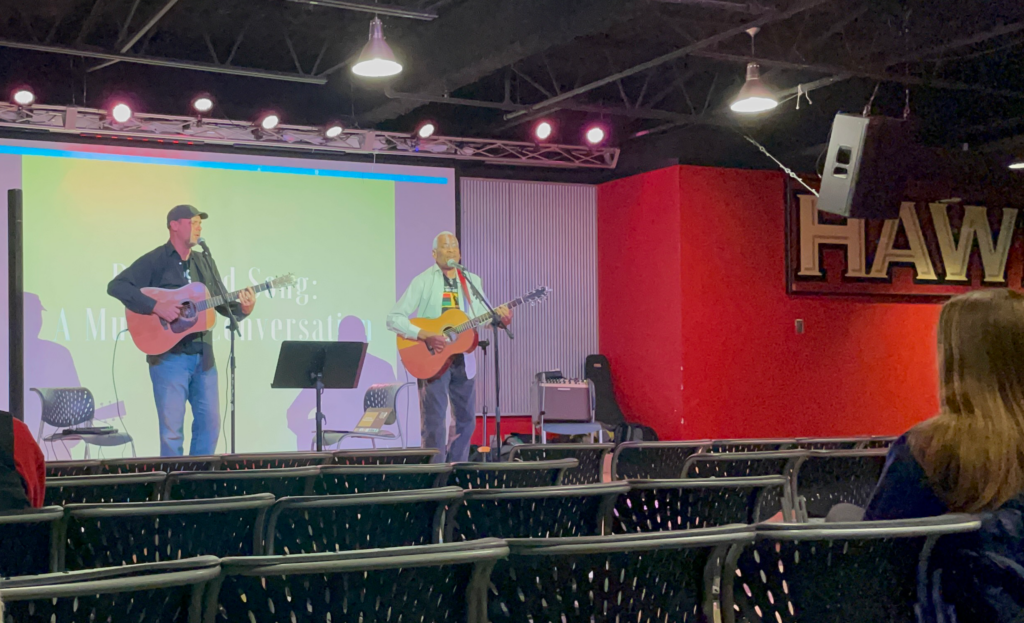
Here’s Reggie (right) with Alastair Moock (who we’ll be listening to later in the semester) performing a version of their Opening Doors Project concert series in the Perch on Oct 3, 2022:
The songs are selected from Kim and Reggie Harris’s albums, Steal Away: Songs of the Underground Railroad (1997), and the sequel, Get On Board! Underground Railroad & Civil Rights Freedom Songs (2007), both recorded and released by Appleseed Records, which is right down the road in West Chester, PA. The songs are:
Kim and Reggie Harris, “Oh Freedom” (1997)
Kim and Reggie Harris, “Follow the Drinking Gourd” (1997)
Kim and Reggie Harris, “Now Let Me Fly” (1997)
Kim and Reggie Harris, “Go Down Moses” (1997)
Kim and Reggie Harris, “Deep River/Swing Low” (1997)
Bernice Johnson Reagon (featuring Kim and Reggie Harris), “Oh Mary, Don’t You Weep” (2007)
To help understand these songs, I’d you to start researching coded language in the songs of slavery. There is quite a bit out there.
I’d also like you to see the liner notes for Steal Away: Songs of the Underground Railroad, including their introductory essay, which is on the Readings and Texts page.
There you will also find an article Sanger Part 1 just the text under the heading “The African American Song Tradition,” which appears on pages 21 – 25 of the text. That and the other readings come from Sanger’s wonderful book, “When the Spirit Says Sing!”: The Role of Freedom Songs in the Civil Rights Movement. Her book is not required, but it can be a resource for you throughout the next few weeks. It’s quite fascinating and readable.
Come to class ready to write about and discuss the songs.
If you have any questions, please let me know.
W 2/4: Black Sprituals from American Slavery; songs of Kim and Reggie Harris
Assignment for Monday, 2/9 The work for Monday is going to move us into the initial stages of the Civil Right Movement and help us start to understand the mindset of the times in terms of race relations. Please complete the work in the order listed, as it is designed to help you understand and work through the song. Your third in-class Interpretation will be Monday.
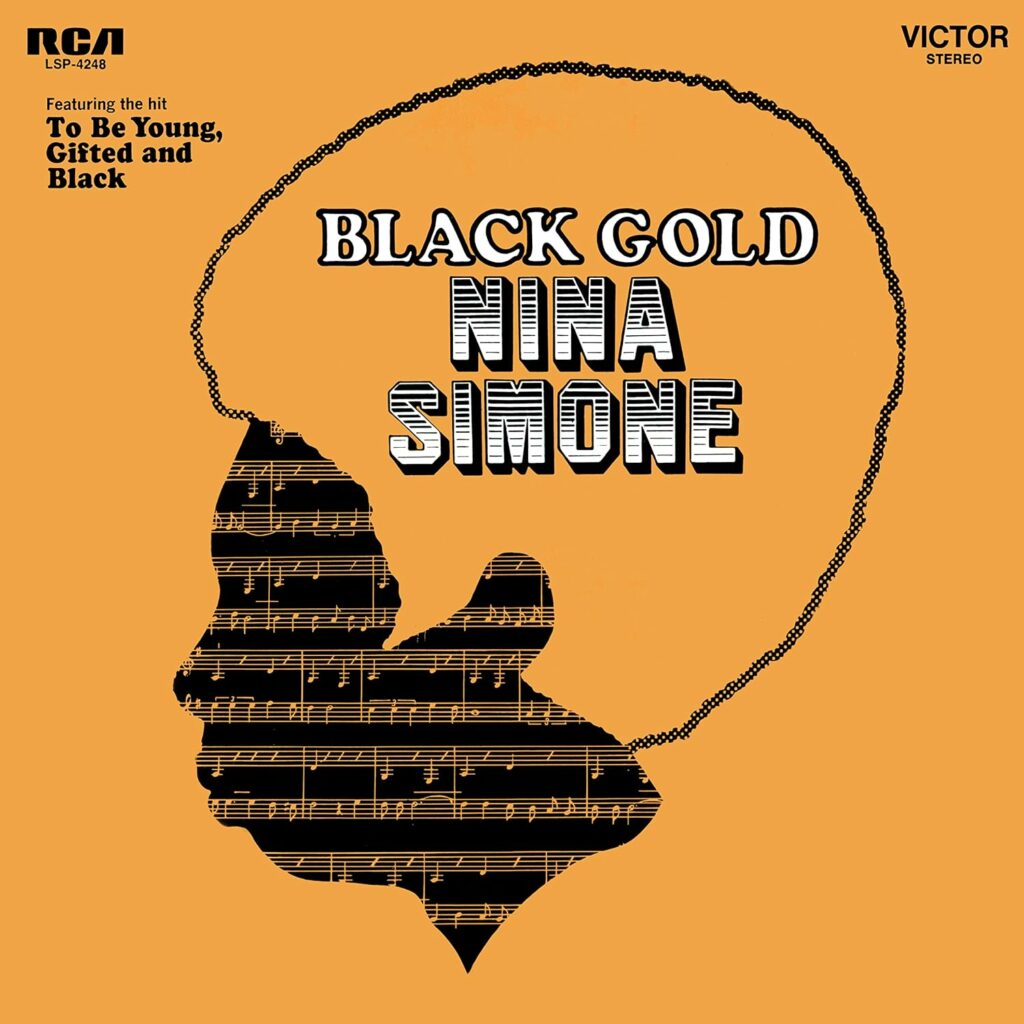
Part 1. Listening to “Strange Fruit” We are going to be focusing on “Strange Fruit” (1939) a song written by Abel Meeropol (under the pseudonym Lewis Allan) and recorded by Billie Holliday about lynching. If you are not familiar with it, please be prepared. I’d like you to listen to “Strange Fruit” by Billie Holliday (1939) three times, which is song 22 on the Protest Music Spotify Playlist. I’d like you to make notes about the music, the lyrics, and her delivery (this is like we did with “Born in the U.S.A.”). Then listen to Josh White’s version (1954) and Nina Simone’s version (1965). You might so some research on these artists and versions.
IMPORTANT: If you are not already logged into your SJU account on the library website, when you click the above link you will be brought to a page with a red GET STARTED button. Click GET STARTED and log in. You should then be able to watch it. If not, after logging in, come back to this page and then click the title again and see what happens.
The documentary gives background information about Billie Holiday’s, “Strange Fruit,” the era in which it was written, its effect on the Civil Rights movement, and why it is still important today. Note that the documentary depicts graphic images and descriptions of lynching and includes the use of racist language, ideas, and images in the presentation of historical events.
At 12:00, the documentary discusses efforts to pass a federal antilynching law. The Emmett Till Antilynching Act was passed and signed into law on March 29, 2022, ten years after the documentary was released and 104 years after the first federal antilynching law was proposed.
Part 3. Research and Interpretation To help you understand the context in which “Strange Fruit” was written, please spend some time with the Monroe Work Today web site, which documents lynchings and other white supremacist activities in the United States (1834 – 1964). Make sure you click on the link to the interactive Map and zoom in to see the individual events.
Find other research paths related to the song, the subject matter, other versions, and perhaps samples, see where you wind up. Just explore.
I’d like to you to spend some time thinking about and jotting down some notes about how (and if) the song—the lyrics, the music, the delivery, the songwriter, the singer—make real the times in which it was released. I’d like you to think about what exactly is the purpose of such a song. Is it entertainment? Lecture? Social commentary? Something else? A combination of many things? How does it work?
If you have any questions, please let me know.
M 2/9: Billie Holiday, “Strange Fruit” (1939); Strange Fruit documentary; Nina Simone, “Strange Fruit” (1965)
Assignment for Wednesday, 2/11 Please read through Project 1 and come to class with a list of 3 possible themes/subject areas you might be interested in focusing on.
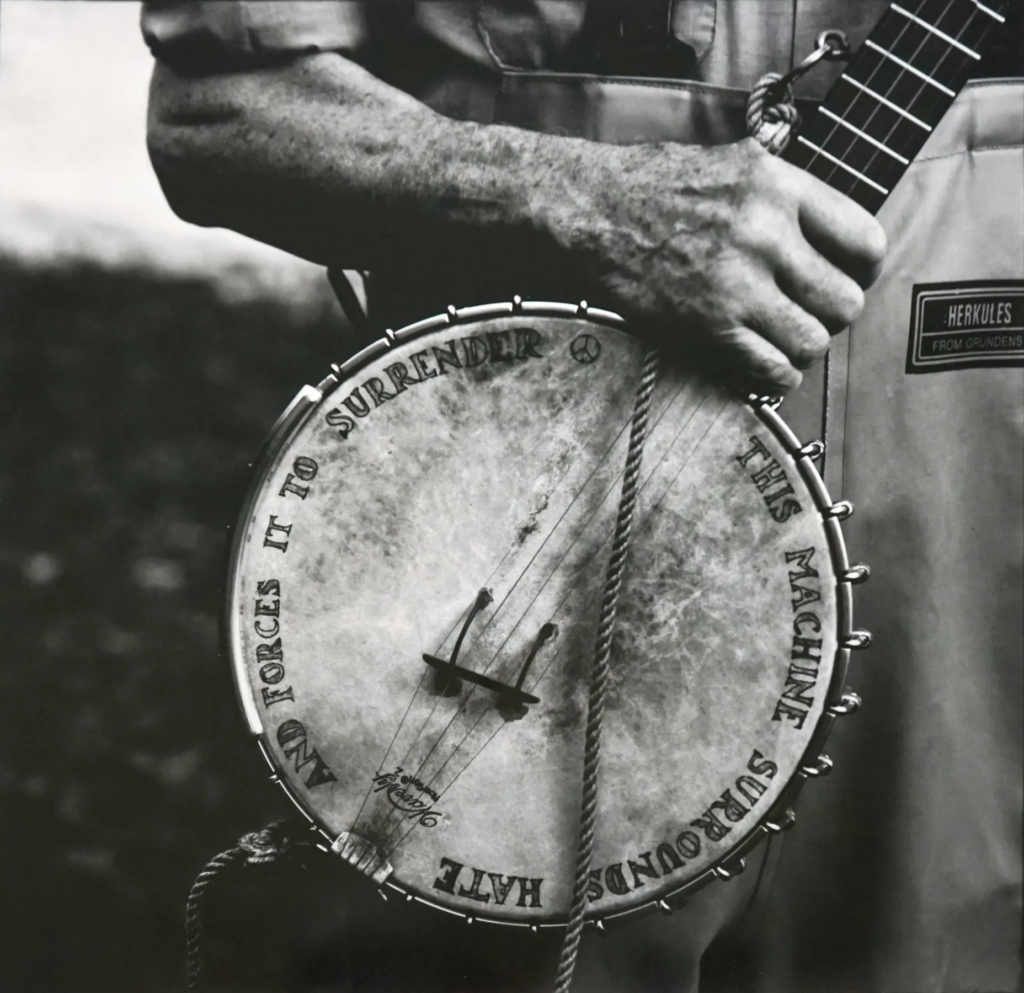
On Wednesday we move to our first artist spotlight, focusing our attention on folk pioneer, Woody Guthrie, who traveled around with “This Machine Kills Fascists” in his guitars.
We are going to focus primarily on his iconic song, “This Land is Your land,” which WXPN host, Raina Douris, once called “the first punk song.” The song as Guthrie recorded and released it seems innocuous enough, though that was because verses 4, 5, and 6 were not allowed in the recording. It’s a song where the lyrics have been transformed by many over time, but I want you to read the lyrics on Woody’s website, paying special attention to the versus that start “As I went walking I saw a sign there, / And on the sign it said ‘No Trespassing.’” You can hear 5 verses sung in the version Pete Seeger and Bruce Springsteen sang at Obama’s first Inauguration.
Do some research on the song’s origins and what it was written in response to.
Please listen to the songs 26 – 35 on the Protest Music Spotify Playlist starting with “This Land is Your Land” by Woody Guthrie, through “This Land is Your land” by Sharon Jones and the Dap Kings (There’s a bonus “Song to Woody” by Bob Dylan in there, too.) “Deportees” is a powerful song written but never recorded by Guthrie. I’ve included a few versions, so you can consider how different deliveries and voices affect your appreciation and understanding. In 2013, NPR did a story on The People Behind Woody Guthrie’s ‘Deportee’ Verses,” which you might be interested in listening to. You can also see the original 1948 AP newspaper article.
Though there is no required Interpretation on Wednesday, I would like you to do some research on Woody Guthrie, who he is, why he and his work are important, and what influences he has had on those who came after him. Please also gain some basic background on the Dust Bowl era, which many of his songs focus on, including Okies.
If you have questions, please let me know.
W 2/11: “This Land is Your Land” (1944) and the songs of Woody Guthrie; “This Land” by Gary Clark, Jr.; notes-for-guthrie.pdf
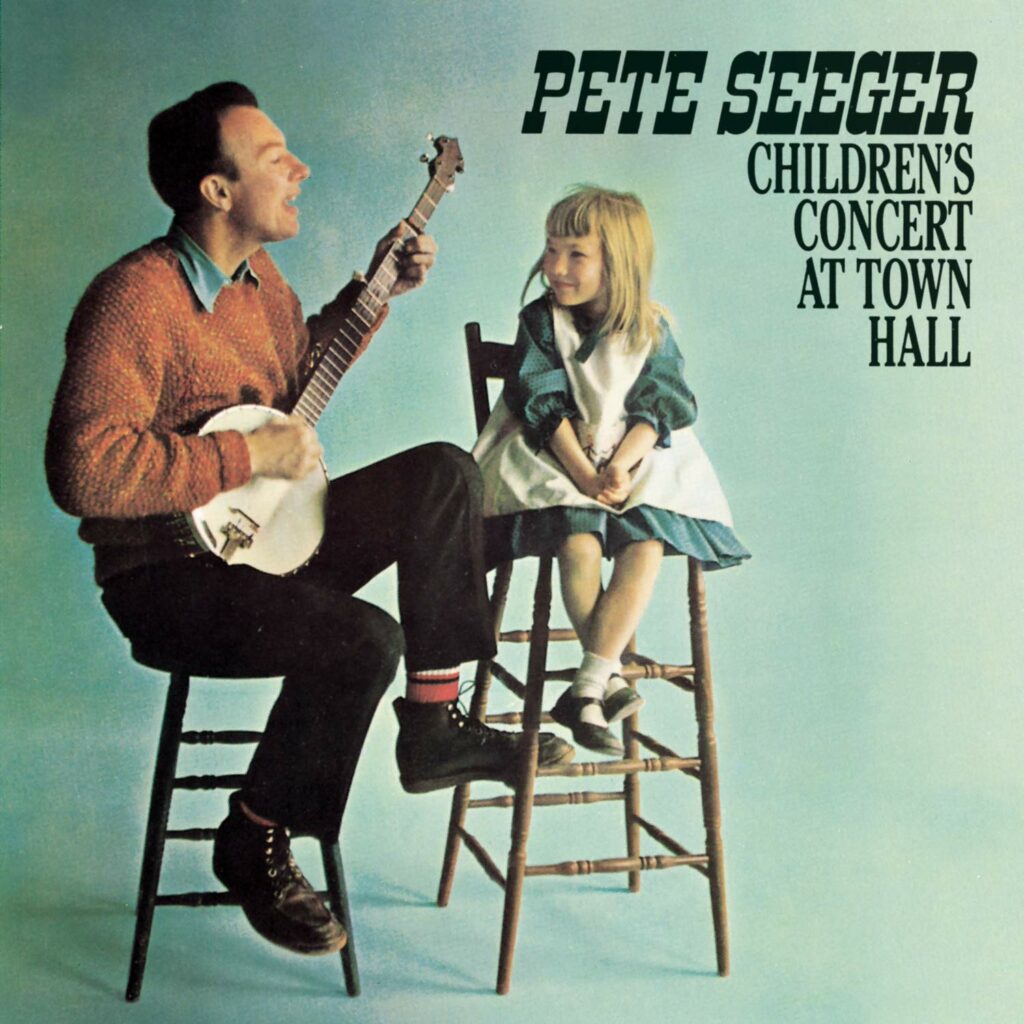
Assignment for Monday, 2/16 The work for Monday is going to continue with the folk tradition be focusing on folk legend and civil rights icon, Pete Seeger. Seeger was a primary figure for just about ever protest movement from the 1930s to his death in January 2014. His life and work influences the Labor Movement and the Civil Rights Movement, extends through the 1950s and McCarthyism, and into the Anti-Vietnam War Movement. So, we’re going to get to know him, his approach, and why he was so important. It is not hyperbole to say that without Pete Seeger (and Guthrie before him) none of the protest music that follow would have have appeared. Your 4th in-class Interpretation will be on Monday.
Please first watch from 00:00 – 1:10:00 of Jim Brown’s documentary, Pete Seeger: The Power of Song (see the Readings and Texts page). You’re welcome to watch the whole thing, of course, but are only required to watch this portion; just after 1:10:00 the documentary moves to his environmental causes, which if you are interested in that, you will find interesting.
I’ve added songs to the Protest Music Spotify Playlist that exemplify Seeger’s work over his career (songs 38 – 49), from “We Shall Overcome” (which he taught to MLK and became the anthem of the Civil Rights Movement) to “If I Had a Hammer” and “Turn, Turn, Turn” (which Peter, Paul, and Mary and The Byrds made a massive hits) to “My Rainbow Race.” He has 100s of songs, so this is a representative sample. Please listen to them.
For your research, I’d like you to focus on the following:
Seeger, his influence, and his legacy
the Folk Movement and what is called the “folk tradition” from 1940 – 1960 (imagine the impact of hip-hop and Taylor Swift today and you can approximate the impact of folk back then)
Race relations and communism in the 1940s and 1950s
McCarthyism, the House Un-American Activities Committee (HUAC), the Black List, and Seeger’s defiance of it
As I started this assignment, there are few, if any, musicians more important to protest than Pete Seeger. Do the necessary research. The Interpretations assignment for Monday will require it.
Please note that there will may also be an Interpretations assignment on Wednesday.
If you have any questions, please let me know.
M 2/16: Artist Focus: Pete Seeger and “We Shall Overcome”
Assignment for Wednesday, 2/18 The work for Wednesday is going to bring us into the Civil Rights movement, specifically looking at the roll of call and response community-based singing. There’s a lot of material on this subject and, as a result, for the first time this semester you have required reading. The material is too important not to have a common base of understanding. You can find both of the readings mentioned below on the Readings and Texts page.
I’d like you to read Sanger’s selections from “‘I Hear Singing in the Air’: Singing as Communication Strategy” from her amazing book “When the Spirit Says Sing!”: The Role of Freedom Songs in the Civil Rights Movement, which covers the transformative nature of the call and response method of singing, both while in church and while protesting. It also touches on the complicated relationship people had with traditional Black songs from the time of slavery. Please read it intentioanlly and deliberatlely, focusing on the ideas about strategic communication and identity formation.
While, Sanger touches briefly on call and response, for more on that I’d like you to read a selection of Bernice Johnson Reagon’s liner notes to the glorious CD box set, Voices of the Civil Rights Movement: Black American Freedom Songs 1960-1966. Reagon was one of the musical leaders of the Civil Rights Movement and is now a music scholar. The whole of the liner notes is fascinating, so I encourage you to read it all, but you are required to read only pages 4 (starting with Roots: Notes on Black American Choral Song Style) to page 16. I’d also like to learn about Fannie Lou Hamer, who we’ll be listening to this week.
As for the songs, I’d like you to listen to songs 50 and 51 on Protest Music Spotify Playlist, which are both by Civil Rights leader Fannie Lou Hamer, as well as the songs from Reagon’s CD listed under the Civil Rights Songs for 2/18 heading on the Readings and Texts page. The CD is not on Spotify so I have uploaded some songs to Dropbox.
The link before the embed includes videos referenced in the story.
Please come to class with handwritten or printed notes on the above subject.
Please come to class with 5 things you are ready to share as part of the discussion. Please have these written on paper so you don’t need your computers open.
In class, we will also be doing a brief proposal for Project 1, so please have chosen theme and list of songs.
Please complete the Project 1 proposal that I handed out in class. If you were absent you can print a copy and complete it: Project 1 Proposal (.pdf).
Assignment for Monday, 2/23 The work for this week is going shift us from the early stages of the Civil Rights Movement to the latter stages by considering the music and times of what has become known as the Black Power movement, which lasted from 1964 to the mid-1970s. Though we very rightly consider the times we live in today as extraordinarily turbulent, the period from 1963 through 1975 was even more. Here are some of the main events:
1963: Children’s Crusade Civil Rights March (May 2) 1963: Medgar Evers Assassinated (June 12) 1963: March on Washington (Aug 28) 1963: 16th Street Baptist Church bombing (Sept 15) 1963: President JFK Assassinated (Nov 22) 1964: Nina Simone Sings “Mississippi Goddam” at Carnegie Hall, NY (March 21) 1964: Freedom Riders James Chaney, Andrew Goodman, and Michael SchwernerMurdered (June 21) 1964: Civil Rights Act Passed (July 2) 1965: Malcolm X Assassinated (February 21) 1965: “Bloody Sunday” march across the Edmund Pettus Bridge (March 7) 1965: Voting Rights Act Passed (August 6) 1965: Watts Race Riots (August 11) 1967: Detroit Race Riots (July 23) 1968: Memphis Sanitation Workers Strike (Feb 12 – April 16) 1968: MLK, Jr Assassinated (April 4) 1968: Robert F Kennedy Assassinated (June 6) 1968: 16,899 Americans Killed in Vietnam War (highest yearly total) 1969: American Indian Movement begins 18-month occupation of Alcatraz Prison (November 20) 1969: Black Panthers Fred Hampton and Mark Clark Assassinated (Dec 4) 1970: Asbury Park race riots (July 4) 1972: Watergate 1975: Vietnam War Official Over
To help ease us into the time period and introduce us to some of the artists, I’d like you to watch the Oscar-winning documentary, Summer of Soul(. . . Or, When the Revolution Could Not be Televised) directed by Questlove on Hulu. It is 1 hour and 58 minutes, but it is an amazing movie. Get out popcorn, invite your friends, and enjoy.
As you watch, I’d like you to identify and think about the themes of identity, racism, empowerment, community, politics, and class — themes we have discussed throughout the semester — and note instances where those themes emerge and how the participants discuss them in relation to the music. Also think about how the songs and how they are presented differ from the call and response music we discussed on Wednesday.
I’d also like you to choose one or two of the bold printed events in the list above and do a deep dive into research about that event. What it was, why it is important, who was involved, etc.
There is no music to listen to for Monday. We will start listening in class.
Your 5th Interpretations will be about the documentary and the event(s) you choose.
M 2/23:Artist Focus: Nina Simone and the Summer of Soul documentaryClass canceled — another snow storm W 2/25: Artist Focus: Nina Simone, the Summer of Soul documentary, and The Black Power Movement artists F 2/27: Midterm Engagement and Presence Due by 11:00pm
Assignment for Wednesday, 3/11 In class on Monday, we listed to and discussed Bob Dylan’s “Blowin’ in the Wind,” “The Times They Are A-Changin’,” and “Like a Rolling Stone” as a way to move into 1960s and early 1970s counter culture, which eventually evolved into the anti-Vietnam war movement. To get a better idea of the time period Dylan is leading into, I’d like you to watch Bill Lictenstein’s incredible 2019 documentary, WBCN and the American Revolution (1 hour 57 minutes), which is described as:
The amazing untold story of the radical underground radio station WBCN-FM set against the profound social, political and cultural changes of the late-1960s and early-70s, using the actual sights, sounds and stories of those who connected through the station, exploding music and countercultural scenes, militant anti-war and civil rights protests and emerging women’s and LGBTQ-liberation movements.
The link above should bring you to it, but you may need to log in with your SJU account.
As you’re watching it the documentary, I’d like you to pay attention and record some time stamps that show or are indicative of what Dylan discusses in his songs. That is, places where we see “times a-changin’,” where we see answers “blowin’ in the wind,” where we see people feeling disconnected and lost; where we see power growing because you are on the margins of society; and so on. Think about how those ideas also translate into anti-Vietnam War songs, too.
I’d also like you to bring to class a list of three songs (none by Dylan) released between 1967 1966 and 1973 1974 that you feel are representative of the time period. Be prepared to talk about them and why you feel they are representative.
We will be having our next in-class Interpretation on Wednesday, where you will be asked to write about the documentary, the time period, and at least one of the songs you have selected. So, be sure to do the necessary research and bring it with to class.
If you have any questions, please let me know.
W 3/11:WBCN and the American Revolution documentary and Anti-Vietnam War songs Review and Update Project 1 Midterm grades due
Week 9: Children’s Music and the Legacy of Pete Seeger
Assignment for Monday 3/16 First, please note that we are meeting in Merion 174 on Monday due to the Misher Festival and America@250 events. As a result, we are opening the class up to others in the university community. Please go directly to Merion 174.
There is no music-related work for Monday. Instead, I encourage you to get started on your Project 1 draft, which is due at the start of class on Wednesday, 3/18. The draft should be at least 50% of the final narrative.
If you have any questions about the narrative, let me know.
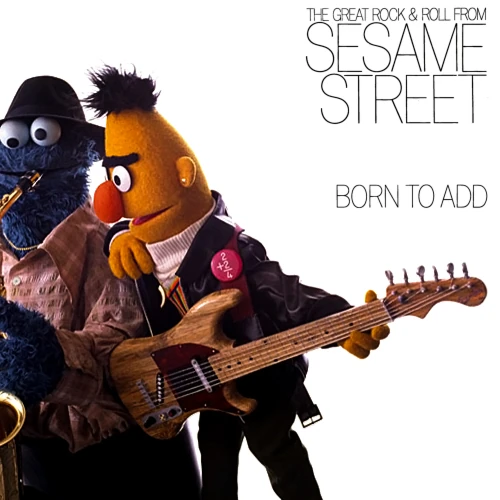
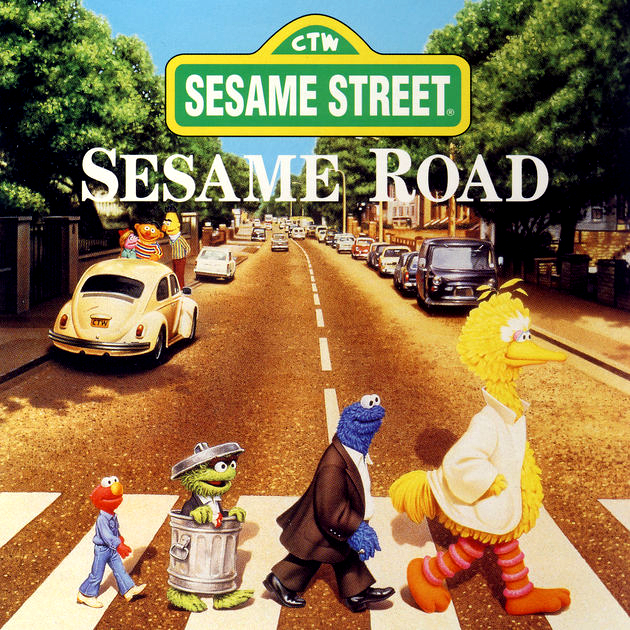
M 3/16: Misher Festival & America@250; Children’s Political Music, Sesame Street, Mister Roger’s Neighborhood; music of Alastair Moock
Protest Music Welcomes America250@SJU and the Misher Festival!
November 12, 1925: A forerunner of PBS and NPR is formed: the Association of College and University Broadcasting Stations (ACUBS). It later becomes the National Association of Educational Broadcasters.
November 21, 1966: Mister Rogers’ Neighborhood debuts on Pittsburgh’s WQED. It premieres nationally on NET Feb. 19, 1968.
November 7, 1969: Johnson signs the Public Broadcasting Act of 1967, authorizing federal operating aid to stations through a new agency, the Corporation for Public Broadcasting (CPB)
November 3, 1969: Public Broadcasting Corporation is incorporated
November 10, 1969: Sesame Street premiers
June 1972: Nixon vetos 2-year CPB funding bill; 1 year approved
March 1980: PBD develops and debuts Closed Captioning
March 1981: President Reagan seeks $88 million cut and gets $35 million cut from funding for CPB, PBS, and NPR
August 1995: Congress votes against amendment to cut all funding for CPB, PBS, and NPR
1995 – 2025: Congress chips away at funding for CPB, PBS, and NPR
July 2025: Congress cuts all funding for CPB, PBS, and NPR
2026: Corporation for Public Broadcasting shuts down (January); NJ PBS will shut down in the summer; other stations will be shutting down, as well.
Mister Rogers’ and Sesame Street
If you’re not familiar with Mister Rogers’ Neighborhood and/or Sesame Street (or even if you are), you might be interested in seeing how the shows opened in 1969:
“Won’t You Be My Neighbor” (February 1969), first full-color episode of Mister Rogers’ Neighborhood
“Everything on Mister Rogers’ Neighborhood is done out of a concern for children’s feelings. . . . And because I am a person who sometimes finds it easier to say important things through songs–that’s what I sing about, too.” — Fred Rogers
“I usually say at the end of each Mister Rogers’ Neighborhood program, ‘You’ve made this day a special day by just you being you. There’s only one person in the whole world like you and people can like you just because you’re you.” That’s meant for children, but it’s meant for parents too.” — Fred Rogers
“Sunny Days” (1969), First opening sequence of Sesame Street
“Chester Pierce, an African-American psychiatrist and Harvard professor, helped design what he called the show’s “hidden curriculum” to build up the self-worth of black children through the presentation of positive black images. Pierce also insisted the show present an integrated, harmonious community to challenge the marginalization of African-Americans that children routinely saw on television and elsewhere in society.
Sesame Street cast member Loretta Long, who played Susan from the show’s first episode through today, devoted a full chapter of her doctoral dissertation to Pierce’s curriculum, which included “locating the show in an inner city neighborhood with old brownstones and lots of trashcans.” Such a setting, the producers concluded, would help “the inner city child relate more to us [cast members] as his neighbors.” Producer Jon Stone said, “For a preschool child in Harlem, the street is where the action is…Our set had to be an inner-city street, and more particularly it had to be a brownstone so the cast and kids could ‘stoop’ in the age-old New York tradition. . . .”
Here are also some pivotal related moments from the shows:
Mister Rogers’ Neighborhood
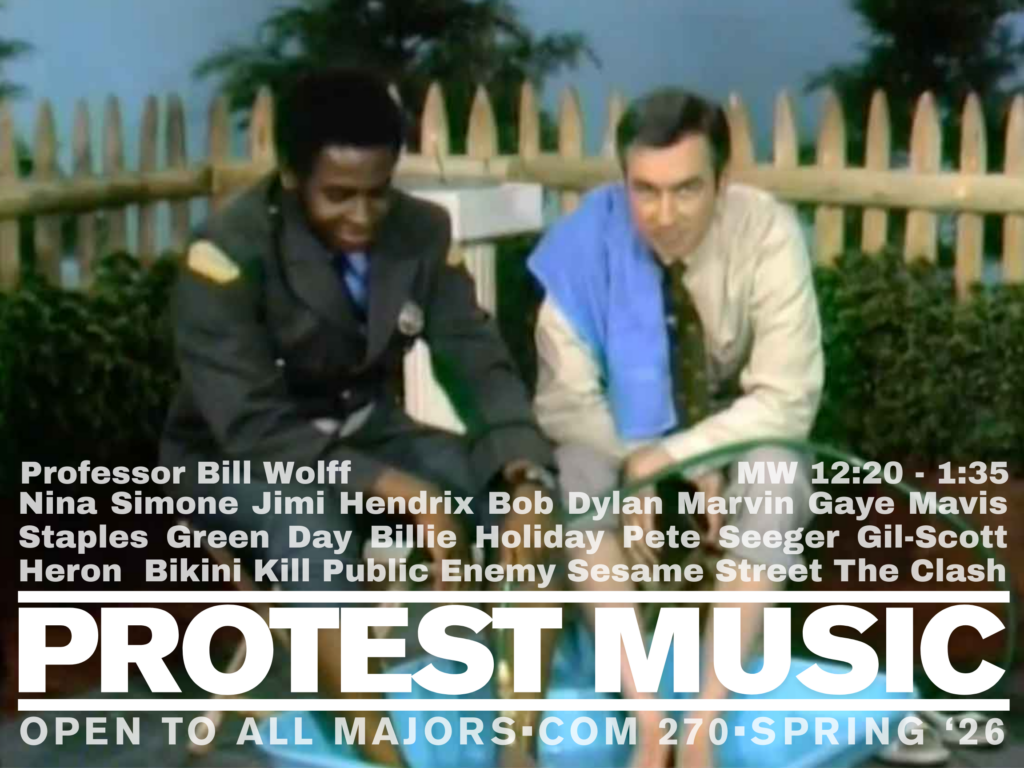
“Sharing a Wading Pool” (1969), Mister Rogers with Officer Clemmons (the article required above for some reason doesn’t have the full scene)
“Sharing a Wading Pool” (1993; start 6:25), Mister Rogers reprises this scene with Officer Clemmons 25 years later.
“It’s You I Like” (1981), Mister Rogers with Jeff Erlanger (song begins at 4:00)
Sesame Street
“He’s Got the Whole World in His Hands” (1969), Mahalia Jackson, widely considered to be one of the most important gospel and blues singers ever, with kids on Sesame Street
Assignment for Wednesday, March 18 Please continue working on the rough draft of Project 1. The rough draft should be at least 50% complete. Please bring 2 printed copies.
M 3/23:No Class — work on Project 1 Final and Project 2 Proposal W 3/25:No Class — work on Project 1 Final and Project 2 Proposal Project 2 Proposal Due by 11:00pm F 3/27: Project 1 Final Due by 11:00pm
Assignment for Wednesday, 4/1 The readings and songs for Wednesday are going to introduce us to Indigenous Protest and Activist songs from artists on Turtle Island (what is now known as North America), as well as be the last songs we listen to from the 1960s. We’ll be focusing primarily on Buffy Sainte Marie, Peter LaFarge, and others. The genres include rock, folk, hip-hop, and singer-songwriter. Sainte Marie has written:
A great three-minute protest song can be more effective than a 400-page textbook: immediate and replicable, portable and efficient, wrapped in music, easy to understand by ordinary people. It’s distributed word-of-mouth by artists, as opposed to news stories marketed by the fellas who may own the town, the company store and the mine.
Please read the article authored by Saint Marie, “The Power of Protest Songs,” that the quote comes from.
Then, please listen songs 109 – 120 on the Protest Music Spotify Playlist starting with “Universal Soldier” by Saint Marie, which transitions us from anti-Vietnam War songs to Indigenous Music, and ending with “Fight Like a Girl” by Raya Zaragoza. The songs range from 1964 to 2020.
I’d like you to use the Native Lands Global Map to try to find the tribal nations mentioned in the songs (you can only search by address not nation) as well as the Lenape, which is the ancestral and present nation where SJU now resides. (You can also just search them on Google, if it’s easier.) Also, enter in your home address and learn about which Indigenous Nations call that land home.
These songs are going to introduce you to many historical events you may not be familiar with. Many are shocking and traumatic. I encourage you to look up as many as you feel comfortable with, but specifically, if your last name starts:
B – Do, I’d like you to look up and be ready to discuss the American Indian Movement and the Occupation of Alcatraz
G – Kn, I’d like you to look up and be ready to discuss Native American Boarding (or Residential) Schools
Ko – McC, I’d like you to look up and be ready to discuss the Wounded Knee Massacre from 1890
McK – Po, I’d like you to look up and be ready to discuss the Wounded Knee Occupation from 1973
Si – Yo, I’d like you to look up and be ready to discuss the controversy surrounding the Kinzua Dam, circa 1960, (updated:) how many treaties with Tribal Nations the US has violated, and the Standing Rock Protests, 2016-2017
Please come to class with a list of 3 printed questions you have about the songs, issues, and/or subjects the songs raise as well as a few lines that really stood out to you.
If you have any questions, please let me know.
W 4/1: Indigenous Protest and Activist Songs: Buffy Sainte-Marie, Peter LaFarge, and others
Assignment for Week of 4/8 There is no class on 4/8 due to required conferences for those who are completing final projects. However, in order to prepare for your conference, I would like you to complete the following work based on the project you are completing.
Podcast I’d like you to listen to radio stories from NPR’s American Anthem series and two former student Protest Anthems:
When listening to the stories, I’d like you to write down (and bring to you conference) each kind of musical, oral, and textual source being used (lyrics, interview, scholar, etc.). I’d also like you to think about how the story moves from one source to the next. And think about how the music itself is being used.
Music Festival (Creative) I’d like you to watch the documentary, Lilith Fair: Building a Mystery (2025), about the creation and lasting impact of the Lilith Fair music festivals. As you watch and are thinking about your protest-themed festivals, I’d like to you consider how the organizers built social justice themes into all aspects of the festival, from musicians to merch to community engagement, as well as how they learned from their mistakes. Also think about the Harlem Cultural Festival.
I’d also like to you to look at and save links for various music festivals that are out there so you can consider how they design their merch. Do not just focus on the big names like Coachella and Firefly. There are many amazing, more local, more regional festivals that draw lots of bands and crowds that would be similar to what you are doing, such as See.Hear.Now. (in Asbury Park) and Railbird (in Lexington, KY). Try to find posters and other merch so you can get some ideas.
Music Festival (Business Plan) I’d like you to watch the documentary, Lilith Fair: Building a Mystery (2025), about the creation and lasting impact of the Lilith Fair music festivals. As you watch and are thinking about your festival business plans, I’d like you to make note of all the expenses that you can glean from the documentary, from performer fees to travel to security to electricity to merch upfront costs and so on. You might also look back on the Summer of Soul documentary, which shows performer fees and contracts.
I’d also like you to do some research on festival business plans and come to your conference with some examples you can show me.
Come to your conference with 5 posters can stand out to you as inspirational.
Album and 45 Redesigns I’d like you to do a deep dive on truly creative and engaging album cover designs. You might start with (but should definitely go beyond) top 100 lists from Billboard and Rolling Stone. Come to your conference with 5 covers that might inspire you (if there are any), as well as a list of 5 albums or 45s (depending on your project) you are considering for your work. Be prepared to talk about each.
Zines Please read through the zines I gave you in class and “Zines” by Stephen Duncombe (1997), who you can find on the Readings and Texts page. Then, I’d like you to do a deep dive into music-related zines and see what inspires you. Save a few and come to your conference with some that inspire you. As you read them, note which techniques and designs inspire you and why.
You might also consider buying a copy of Overthrow the Status Que: A Super Rad Kickass Primer about Zines, which is $12 on Etsy. I have assigned this in the past and am trying to find my last copy of it, but in case I can’t, it is an absolutely amazing and, well, kickass, primer on zines.
Okay, I think that’s everyone. If I missed your project area, please let me know and I’ll update this!
I will also email letting you know when the homework for Monday, 4/13 is online.
Assignment for Monday, 4/13 The work for Monday is going to build on the documentaries and work on protest by introducing us to two anti-racist movements–Rock Against Racism in the 1970s (created, in part, after racists remarks by Eric Clapton andthe general rice of white nationalism in Britain in the 1970s) and Artists Against Apartheid on the 1980s (created Stevie van Zandt, a member of Springsteen’s E Street Band)–while also bringing us into the punk movement of the 1970s.
First, I would like you to do some research on both Rock Against Racism and Artists Against Apartheid. Go beyond the Wikipedia pages, find footage and article (there’s scholarship out there on these, too), as well as about the artists who were involved and the reasons they were created.
Then, I’d like you to watch the amazing documentary about Rock Against Racism, White Riot (2019, directed by Rubika Shah). You can watch it for free (with ads, I think) over on DailyMotion. You can also watch it on Amazon Prime but will need to either rent it or get a free 7-day trial membership to Film Movement+. (I’m waiting to hear if we can get a free version from SJU and will update the assignment when I hear).
I’d also like you to listen to songs 121-130 on the songs on the Protest Music Spotify Playlist. They include songs that were sung at Rock Against Racism (but not from the event; they aren’t online) and Sun City, the album created by Artists Against Apartheid. I also include a version of “Silver and Gold” performed by U2 that appeared in the documentary and album, Rattle and Hum, where Bono briefly discusses the song origins.
We will be back to our in-class hand-written Interpretations on Monday (the first of the the last three of the semester). As you are preparing for it, remember to bring your research with you to class and prepare to quote and cite it. Think about the relationship between and among regular people and musicians to create anti-racist movements. Think about what artists and people can do when they dedicate their time and energy. Think about this in relation to what we saw a few weeks ago during the No Kings Marches (you might also see Dropkick Murphy’s performance at the Boston rally).
If you have any questions, please let me know.
M 4/13:White Riot documentary, Rock Against Racism, and Artists Against Apartheid
Assignment for Wednesday, 4/15 For Wednesday, we’re going to build on what we watched and talked about for Monday by diving into the mosh pit with 70s punk. I’d like you to listen to blast songs 131 – 147 on the Protest Music Spotify Playlist, which ranges from “Search and Destroy” (1973) by the Stooges to “London Calling” (1979) by The Clash. Play them as loud as you can, just as they were intended to be played.
I’d also like you to listen to the first two songs, “God Save the Queen” and “I Wanna Be Me,” from Sex Pistols January 14, 1978 concert at Winterland (you’re welcome to watch the whole incredible concert, of course, but you’re not required to).
I’m not assigning an academic reading about punk because I know you have your projects to work on, but for class on Wednesday I’d like you to consider what can we learn about punk based on what we listened to, saw at the concert, and the photos we looked at? Think about how the following interact together generate meaning:
band names
vocal delivery
musical performance
lyric subject matter
fashion
album art
I’d also like you to choose one of the bands we’re listening to for today and do some brief research about them. Come ready to talk a fe wof their songs.
Assignment for Monday, 4/20 Please listen to songs 148 – 154 on the Protest Music Spotify Playlist, which range from “Double Dare Ya” (1991) by Bikini Kill to “Bloody Ice Cream” (1998) by Bikini Kill. Please note that the songs contain sensitive topics, but they are also the more tame of the songs that could be chosen. If you are interested in the more graphic and violent songs so you can get a fuller understanding of the bands and their messages, please see the full albums.
Unlike in the past, where I have asked you to find readings on the texts, this time I am going to assign some readings, which you will be able cite for the research part of the in-class, hand-written Interpretation we’ll be doing on Monday. I would, however, like you to do some background research on the bands we’re listening to, just to give you some context.
Then, linked from the Readings and Texts page, please read Darms “Introduction” and Fateman’s essay, along with the Riot Grrrl Examplesfor 4/20, which contains 70+ pages of Riot Grrrl zines (scroll downuntil you see the heading). You might try to keep the zine examples open as you read Darms’ and Fateman’s essays so you can move back and forth between examples and articles. Darms’ essay serves as the introduction to the important Riot Grrrl Collection book and Fateman’s is a short memoir-type piece about her experience with the Riot Grrrl movement that also appears at the front of the book.
I don’t expect you to read every word of every page of the zines. There are many examples just to show you the range of designs and content. Read what interests you and skip what doesn’t. As with the songs, the zines cover and depict sensitive topics.
Required: Please print out one of the zine pages you feel exemplifies the goals and messages of the Riot Grrrl movement and bring it to class. You’ll use it for your Interpretation.
If you are interested, please watch some of the videos under the heading, pussy riot videos for 4/20. Before you do, look up the band Pussy Riot to learn about the context for their work.
As you are reading the essays, zines, and, perhaps, watching the videos, I’d like you to think about the Riot Grrrl movement as a communication movement. Consider what the movement is communicating and what in, about, and by the movement is doing the communicating. Look to the lyrics, music, written content, designs, visuals, and so on. Consider the process of creating all this work and what that communicates, as well.
Monday will be the second to last in-class, hand-written Interpretation.
Assignment for Wednesday, 4/22 Wednesday we move on to early rap and Golden Age Hip-Hop with songs 155 – 171 on the Protest Music Spotify Playlist. They range from “Rapper’s Delight” by the Sugarhill Gang to “Lost Ones” by Ms. Lauryn Hill and contain some of the greatest and most impactful songs ever released. They contain sensitive subjects and coarse language. Please also watch these two videos:
Rap and hip-hop are the most complex and nuanced genres we’ll be listening to for the semester and it’s a shame we don’t have more time for them.
So, please listen to the songs on the playlist, watch the videos, do some research on the artists and the contexts in which the songs were composed, and come to class with 3 written topics for discussion and/or questions about what you hear, what you feel, and what you have learned.
If you have any questions, please let me know.
W 4/22: Hip-Hop from “Rapper’s Delight” to “Lost Ones”
Assignment for Monday 4/27 As we discussed in class, Monday will be our last class meeting due to a scheduling conflict with a COM Week event.
I’d like everyone to bring in an album or two that is particularly meaningful for them for one reason or another. If you have it on vinyl, bring it in and we can play a track or two from it on the turntable. If not on vinyl, just know what album it is and we can pull it up on Spotify. The album doesn’t need to be about protest or social justice issues, but it certainly can be.
We will be doing our final Interpretation at the start of class, which will be about to the album you have brought it, so do some research behind it and the songs on it. Look closely at the lyrics to see if there are protest, social justice, economic, and/or socio-political themes hidden in there (like in Eminem’s “Lose Yourself”).
Since there is no other work, I strongly encourage you to get started in earnest on your final projects. Waiting until the last minute will only hurt the quality.
If you have any questions, please let me know.
M 4/27: last class meeting Beyonce’s Lemonade W 4/29:class canceled due to COM Week event scgeduling conflict
Monday, May 4: Final Exam, 1:00pm – 3:00pm in Merion 150 Monday, May 4: Final projects due by 11:00pm Tuesday, May 5: Final Engagement and Presence / Final Reflections due by 11:00pm